Hardwood sustainable yield
We reassess the sustainable yield from hardwood forests every five years, or more frequently as required. Read our interim report completed after the 2019-20 wildfires.
Sustainable yield is the amount of timber that can be responsibly harvested from forests each year over the long term. We regularly model and review the sustainable yield from State forests.
We reassess the sustainable yield from hardwood forests every five years, or more frequently as required. Read our interim report completed after the 2019-20 wildfires.
Our sustainable yield assessments are indepdently reviewed each time they are updated. Read the independent review of the interim report completed after the 2019-20 wildfires.

Our sustainable yield model for native forests is called FRAMES. We reconcile yields predicted by FRAMES and actual yields to continuously improve the model, and publish reconciliation reports.
The sustainable yield is the volume of timber that can be responsibly harvested from the forest without reducing future timber stocks.
The sustainable yield doesn’t model the number of trees in the forests, it models the quality and quantity of timber that can be produced from State forests that are identified for timber production, in compliance with the environmental regulations.
Sustainable yield models inform how much timber of each product type can be allocated under long-term supply contracts.
In plantations, large areas are planted with trees the same age and species and the sustainable yield is calculated using data about the size of the area planted, the age of the trees and growth rates.
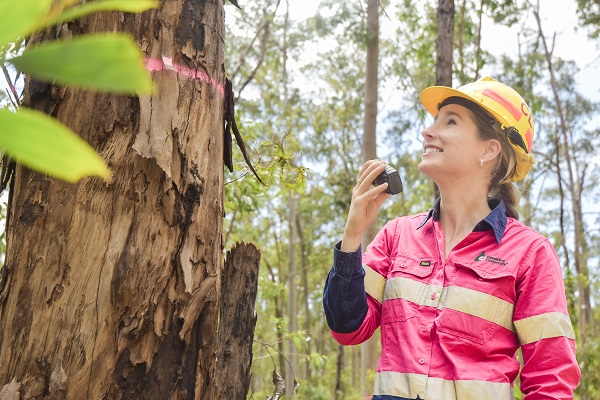
Native forests maintain a natural structure, with trees of different species and ages naturally germinating and growing side by side, some of which are set aside for habitat, biodiversity and waterway protection and others of which are periodically harvested for renewable timber. It takes 30 to 40 years to grow a tree that will produce high quality timber and we harvest about one per cent of the areas we manage each year.
Different tree species are found in different forests and grow at different rates, so our models reflect:
We use this data to generates detailed models that show how much timber of which types and species can be responsibly harvested in each region each year while ensuring the amount of timber available in the forest does not decline over the long term.
Our model is known as the Forest Resource and Management Evaluation System (FRAMES). FRAMES has been used for more than a decade and the models have been continually adjusted and improved based on input over this time. FRAMES was independently reviewed by the Auditor General in 2009, with all recommendations subsequently carried out, and more recently in 2017. A range of reports, reconciliations and reviews are available on our website.
We constantly recalibrate our models and regularly update data inputsto account for changes in regulations or in the forest and ensure that long term growth modelling is as accurate as possible.
We measure inventory plots and assess both standing and felled timber to account for the rate of unseen internal defects on high quality timber production. We also maintain a 10 per cent ‘headroom’ or margin of error in the models.
Each time a reassessment is completed, it is independently reviewed drawing on comprehensive technical data and sensitivity analysis.
The 2019-20 fires impacted a higher proportion of the estate than any previously recorded fires and, in many areas, the intensity of the fire was severe. We completed an interim review of the sustainable yield models to assess the impact of these fires on the long term available timber resource using the best available data immediately after the fires. This was a detailed process that is described in the Sustainable Yield Review Report.
Following the interim review, we started work to complete a more detailed review. Inventory measurements of both strategic and permanent growth plots located throughout State forests commenced in late 2020 to gather data to inform a robust review. The updated sustainable yield models are being finalised.