Visitor advice - Put safety first
Forests contain many unseen and unpredictable hazards that cannot be removed or controlled.
Because of this, you are entering State forest areas at your own risk.
- Check conditions before you go, and tell someone where you’re going and when you expect to be back.
- If you are bushwalking or camping, make sure you have the right equipment, including a map, extra clothing, first aid kit and torch.
- Water is provided at some sites, but always carry adequate drinking water just in case. If you haven’t taken enough water with you, boil water in high-use or low-water-flow areas for five to ten minutes before drinking.
- When walking, wear sturdy footwear (not thongs or sandals). Ticks and leeches are common, particularly over warmer months.
- Be careful camping under trees, especially during windy weather when branches are more likely to fall.
- Drive according to road, traffic and climatic conditions. Make sure your vehicle is roadworthy before your trip. Get out and physically check any obstacles before committing yourself to crossing it.
- Look out for possible road hazards such as holes, ruts, slips, drainage structures, fallen trees, collapsed bridges and the like.
- Derelict and abandoned mine shafts may be present on State forests. Stay to formed roads and trails.
- Don’t speed and look out for log trucks and other road users.
- Be careful after rain or snow when road surfaces can be hazardous.
- Watch out for native animals when driving through bushland areas – for both your and theirs.
- Obey signs and respect road closures due to timber harvesting, fire or other incidents. Find out more about signs in State forests.
- Leave gates as you find them. Do not use roads and tracks on private property without the owner's permission or other areas closed to the public.
- Ring triple zero (000) in the event of an emergency
Drive safely
Road rules and vehicle registration requirements still apply on roads and fire trails on public land - vehicles must be registered, drivers/motorcycle riders must be licenced and safety equipment required by law must be worn. When driving, keep to the formed public access roads and don’t bush bash. Fire trails may be used in State forests and some Crown reserves.
Forestry Corporation has a 60 km/hr speed limit, unless otherwise signposted, on all unsealed gravel roads make forests safer for all road users. Please observe the speed limits of the forest and drive safely.
At lower speeds:
- drivers have more time for decision making
- vehicles have much shorter stopping distances
- crashes that do occur result in less severe injuries because of the lower impact.
Engaging 4WD when entering gravelled surfaces, creek crossings and/or causeways is recommended for vehicles that have the capacity. This will prevent traction loss and damage to roads and water accesses.
Fire safety and fire bans
- Please observe the fire dangers of the day. Listen to local radio stations for advice and only light fires when allowed and where fireplaces are provided. Check the NSW Rural Fire Service website for further information, including declared Total Fire Bans.
- During a Total Fire Ban no fire may be lit in the open. This includes incinerators and barbecues which burn solid fuel such as wood or charcoal. You may use a gas or electric barbeque, but only if it is under the direct control of an adult, the ground within two metres of the barbecue is cleared of anything which could burn, and you have an immediate and continuous supply of water available.
- Solid fuel fires may also be in place in some State forests. Check for solid fuel fire bans before you visit.
- Never leave a campfire unattended, make sure that your campfire does not escape, and extinguish it completely before leaving.
Check if you need a permit
- Fishing on public land requires a permit. Contact NSW DPI.
- Bulk firewood collection will require a permit from Forestry Corporation.
- Authorised hunting for feral animals such as pigs, goats, foxes, rabbits and wild deer is only allowed at sites specifically declared and open for hunting. Hunters must have a valid licence and written permission and are limited to specific areas of the forest. Visit www.dpi.nsw.gov.au/hunting for more information. All other recreational users are still permitted to visit public lands declared and open for hunting, unless a forest has been closed.
- Many organised activities in State forests require a Permit.
Be aware of other activities in the forest
State forests are working forests with many different activities taking place every day. Over 4.8 million tonnes of timber is harvested from NSW State forests every year. Forestry Corporation of NSW staff and contractors work in the forest. Sometimes worksites are visible like harvesting operations where areas will be closed and signs erected. At other times, workers may be in smaller groups undertaking tasks like surveys for plants and animals and their presence is not as obvious.
Forests are also used by groups and individuals for a wide range of recreational activities. Mountain bike riding, camping, walking, trail bike riding, 4WDing, horse back riding – all these activities take place in State forests. A number of State forests have also been declared for recreational hunting. Not all forests declared for hunting are open to hunters all of the time.
For information on which forests are available for hunting and the rules around hunting in State forests visit www.dpi.nsw.gov.au/hunting.
Pay attention to signs in the forest
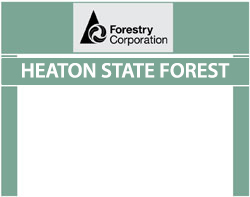
It is important all forest users are familiar with and adhere to the signs used in forests. Visitor sites in NSW State forests including picnic areas, campgrounds and walking trails are generally signposted with signs like those shown below.
Operational signs
Forest operations include timber harvesting, site preparation and road construction. A range of signs are used to ensure public and worker safety while operations are underway. Signs used in the forest which restrict public access include the following:
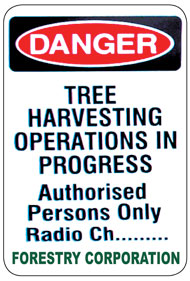
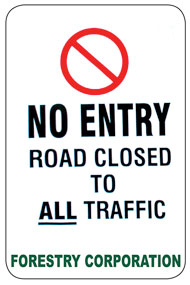
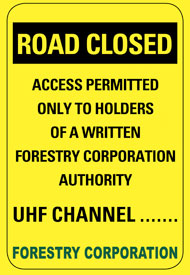
Signs used in the forest to indicate that additional awareness and safety precautions are required such as driving more slowly as work is being undertaken nearby and where heavy vehicles may be encountered include:
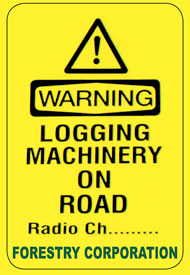
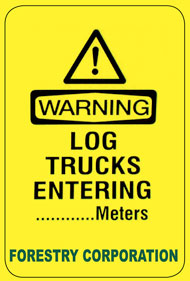
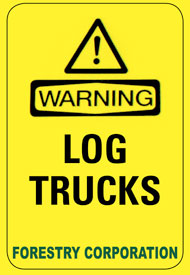
You may also see signs that indicate how you can communicate with other vehicles on forest roads and in the area.
Heavy vehicles can be encountered frequently in working State forests, especially in plantation areas where operations take place at night and on weekends in some areas.
For further information on using forest roads safely including sharing the road with heavy vehicles visit the visiting forests section of this website.
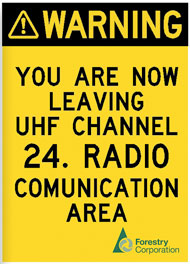
Hunting signs
Hunting areas
State forests available for recreational hunting will be signposted as follows.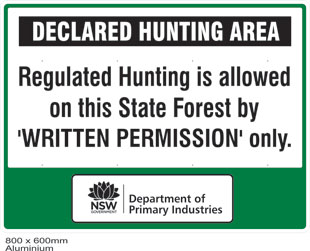
These signs advise the particular forest is available for hunting and reinforce that both a Written Permission and an R-licence are required before entering the forest to hunt.
These signs will be placed at key entry points to each State forest available for hunting. There are a range of other controls in place to ensure recreational hunting takes place in as safe a manner as possible. For information on these visit www.dpi.nsw.gov.au/hunting.
Hunting exclusion zones
Sometimes there is a need to exclude an area of a declared State forest from hunting. This may be because Forestry Corporation of NSW staff are working on the site or there is a recreational event taking place.
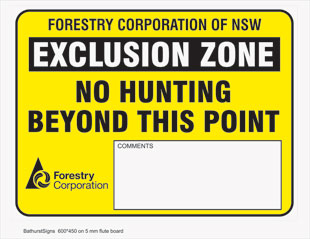 When an area is excluded, this sign is placed to alert hunters and the general public that the area is excluded from hunting and that other people may be present in the area. The sign will have extra information in the comments section to advise on who to contact or the dates that apply to the exclusion.
A number of sites like camping areas are permanently excluded from hunting in State forests and these are shown on maps provided to hunters as part of their Written Permission. For information on these visit www.dpi.nsw.gov.au/hunting.
Hunters should also be aware that while major activities or works may be signposted in this way, there are still likely to be other visitors and workers present in the forest at all times. The conditions in the Written Permission issued to R-Licence holders must be followed at all times.
Contact us
General Inquiries
Call 1300 655 687 during business hours or email: info@fcnsw.com.au